Justice Harlan and President Trump Are Right About Birth Tourism
Justice Harlan provides a middle ground for the Supreme Court on the question of birthright citizenship.
The conventional wisdom is that the Supreme Court will strike down President Trump’s entire birthright citizenship order. In 2018, I wrote that children of illegal aliens are citizens at birth. I’ll admit that recent scholarship has made this question much closer than I had realized, but on balance, Trump’s order should not stand for the children of illegal aliens who are domiciled in the United States. The analysis, however, differs for the second part of Trump’s order, which applies to children of mothers on tourist or other temporary visas. And for authority, the Supreme Court can rely on an unexpected source who came up at oral argument: Justice John Marshall Harlan.
In a 1898 constitutional law lecture, which I analyzed more than a decade ago, Justice Harlan told his students that the children of tourists, “who cannot under the law become naturalized in the United States,” would not be birthright citizens. During oral argument at the Supreme Court, Justice Neil Gorsuch and counsel for the ACLU dismissed Harlan’s views because he dissented in the landmark case of United States v. Wong Kim Ark. But that decision did not set a binding precedent on the status of temporary sojourners. More importantly, the views of the Great Dissenter, whose dissents were often vindicated by history, should not be dismissed so casually. If Harlan was right, then the Supreme Court could split the difference on Trump’s order: the children of illegal aliens who intend to stay in the United States would retain birthright citizenship, but pregnant women could no longer come to the United States on temporary visas for the purpose of giving birth to citizens.
From 1889 to 1910, Justice John Marshall Harlan taught constitutional law at the Columbian Law School, which would later become the George Washington University School of Law. On March 5, 1898, the Supreme Court heard arguments in the landmark case of United States v. Wong Kim Ark. In this case, a child was born to Chinese parents who were not American citizens, but had a lawful status and were domiciled in the United States.
Two weeks later, on March 19, Harlan discussed birthright citizenship in class. Harlan said the child of a freed slave would clearly be a citizen. A student asked if the children of Indians would be citizens. Harlan replied that the Supreme Court held the answer was no in Elk v. Wilkins (1884). The vote in that case was 7-2. Justice Horace Gray wrote the majority opinion, with Justice Harlan in dissent. Harlan said, with some self-deprecating humor, “I had the misfortune to differ from the Court upon that question, and of course I was wrong.”
Next, a student asked, “Would a Chinaman born in this country be a citizen?” Harlan quipped that this issue was now “under consideration” and “has not been decided.” Yet Harlan went on to discuss the case. (Thankfully, no one at the time could post these remarks to social media.) He explained that under the government’s position, the child of Chinese parents who “could never become naturalized citizens of the United States” could not become a citizen “by the accident of his birth in this country.” On the other side, Wong Kim Ark argued: “that the very words of the Constitution embrace just such a cause.” Harlan mused, “How it may be decided, I do not know.”
On March 19, the Supreme Court decided Wong Kim Ark by a 6-2 vote. Justice Gray, like in Elk, wrote the majority opinion. But, unlike in Elk, the Court ruled that Wong Kim Ark was a citizen at birth. And once again, Justice Harlan was in dissent, now with Chief Justice Melville Fuller. The majority stated that under the English common law, children of those “temporarily sojourning” through the land would be citizens at birth. The dissent, however, argued that the Fourteenth Amendment expressed a “different view,” and the children of a “temporary or accidental sojourn” would not be birthright citizens. Despite this disagreement, the Court did not set a binding precedent about the citizenship status for children of temporary sojourners. This issue was not squarely presented, as Wong Kim Ark’s parents “established and enjoyed a permanent domicile and residence” in San Francisco, even if they had no path to citizenship.
In his final class of the semester, on May 7, 1898, Justice Harlan discussed Wong Kim Ark. He explained that under the majority opinion, Wong Kim Ark was a citizen at birth. Harlan remarked, “I was one of the minority, and of course I was wrong.” Yet, based on the context, it seems clear Harlan did not think he was actually wrong. He defended his position about temporary sojourners with a hypothetical. “Suppose an English father and mother went down to Hot Springs [Virginia] to get rid of the gout, or rheumatism.” While on holiday, “a child is born.” Harlan asked, would that “child [be] a citizen of the United States, born to the jurisdiction thereof, by the mere accident of his birth?” Harlan said no, because the tourist parents could not “under the law become naturalized in the United States.” They were on a temporary trip and had no intention of staying. To be sure, Harlan viewed Chinese people as a foreign race that could not assimilate, but the Scotch-Irish Justice had no similar hostility towards the English. Harlan quipped again, “Of course, I am wrong, because only the Chief Justice and myself held these views, and as the majority decided the other way, we must believe that we were wrong.” But Harlan clearly didn’t think he was wrong. I also do not think so.
In the birthright citizenship case, the ACLU argued that Justice Harlan’s views on temporary sojourners should be rejected. And Justice Gorsuch, reciting the “Hot Springs” hypothetical, likewise discounted Harlan’s actual views about tourists. Harlan’s views should be entitled to more deference, even when he was in dissent.
The Fourteenth Amendment was ratified in 1868. Wong Kim Ark, which was decided three decades later, should not be seen as a clear reflection of the original public meaning of the Fourteenth Amendment. The justices in the majority and dissent, who all lived through the ratification of the Reconstruction Amendments, vigorously disagreed on that original meaning. The value of Wong Kim Ark lies in its status as a judicial decision. Wong Kim Ark set a precedent about the status of children born to aliens who are domiciled in the United States, but there is no similar holding about temporary sojourners who do not intend to stay in the United States.
Where there is not a binding precedent about the original meaning of the Fourteenth Amendment, I would line up behind Harlan over other members of the Court from the late nineteenth century. Consider Harlan’s track record. In 1896, the Supreme Court decided the notorious case of Plessy v. Ferguson by an 8-1 vote. The majority established the so-called “separate but equal” doctrine, which approved the Jim Crow regime. Justice Harlan was the only member who recognized that separate cannot be equal. Five members of the Wong Kim Ark majority also joined the Plessy majority. Harlan’s dissents would also be vindicated in other landmark cases. In The Civil Rights Cases (1883), Harlan recognized that Congress had the power to eradicate the vestiges of slavery. In Pollock v. Farmers’ Loan & Trust Co. (1895), Harlan found that the federal income tax was constitutional. In United States v. E.C. Knight (1895), Harlan found that Congress could regulate manufacturing as a form of commerce. In Lochner v. New York (1905), Justice Harlan upheld a law regulating bakers’ hours. And I could go on. The track record for Justice Horace Gray pales in comparison.
Justice Harlan provides a middle ground for the Supreme Court. During the oral argument, Chief Justice John Roberts asked how significant a problem “birth tourism” is, where pregnant mothers come to the United States for the sole purpose of giving birth to a citizen and returning home. The Solicitor General estimated that more than a million pregnant mothers from China have given birth in the United States, and there are companies in Miami that cater to Russian elites. While birthright citizenship is generally popular and deeply entrenched, so-called “birth tourism” is far more controversial, and generally, only wealthy elites can rely on it. The Supreme Court should follow Justice Harlan’s lead and sever the executive order in half. Children of illegal aliens are citizens at birth, but children born to pregnant women on temporary tourist visas are not. The federal government could simply decline to issue citizenship documentation when a child’s mother has such a temporary visa.
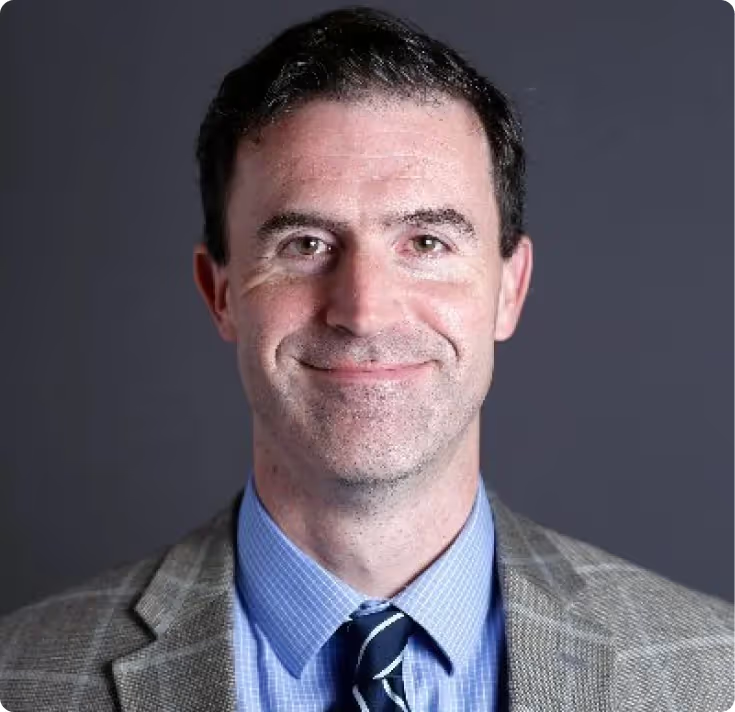
Josh Blackman holds the Centennial Chair of Constitutional Law at the South Texas College of Law Houston, is a contributing editor to Civitas Outlook, and is an adjunct fellow at the Manhattan Institute.

Why Justice Alito Should Not Recuse from 'Suncor v. Boulder'
Fidelity to the law as written has been the hallmark of Justice Alito’s twenty years on the Court.
“Texas” and Confessions of Error in the U.S. Supreme Court
Prosecutors have a duty to see justice done.
.jpg)
Our American Legal Tradition Is Not the Warren Court’s Tradition
Most Americans today have no living memory of the world before the Warren and Burger Courts.




Get the Civitas Outlook daily digest, plus new research and events.
Get the Civitas Outlook daily digest, plus new research and events.