
U.S. Can’t Cave to Europe’s Anti-Growth Agenda

Global security depends on a strong Europe. That won’t happen until the EU ceases its regulatory imperialism.
The EU’s regulatory overkill on climate and tech is hindering a pro-growth trade deal between the U.S. and its largest trading partner. After Brussels agreed this summer to ease emissions policies and reduce other trade barriers, EU regulators in recent weeks have slapped censorious fines on social media platform X, opened investigations into Amazon, Microsoft, Meta, and Google, and declined to rein in far-reaching climate mandates that impose liability on activities outside of Europe. One does not have to support protectionist tariffs or protracted trade wars to see why Washington needs to continue using trade as leverage to pressure Eurocrats to give up micromanaging tech platforms and supply chains around the world.
As JPMorgan CEO Jamie Dimon recently pointed out at the Ronald Reagan National Defense Forum in California, Europe has a “real problem” with overregulation, which has flatlined economic growth across the EU. Around the time of the Great Recession, the U.S. and EU GDPs were roughly equal. America’s economy is now over 50 percent larger, a whopping $10 trillion difference that’s roughly equal to the combined GDPs of Germany, France, and Italy, the EU’s three largest economies.
Europe’s stagnation is self-inflicted. EU rules have driven out innovation. According to the “Constitution of Innovation,” a manifesto published last month by three European academics (one of whom is a former EU lawmaker), the descent started when Brussels ditched its initial mandate of eliminating trade barriers between member states for “the superstition of regulation,” a one-way ratchet toward an ever-expanding bureaucratic state. “Each new regulatory text justified the next,” they write, “creating a governance culture where ‘more Europe’ became the answer to every question.”
The trio singles out climate and digital technology as noteworthy examples of Europe’s regulatory overreach. Both are flashpoints in the ongoing trade negotiations between the U.S. and the EU.
As part of this summer’s tariff deal, the EU promised to relax its signature climate mandates — the Corporate Sustainability Due Diligence Directive (CSDDD) and Corporate Sustainability Reporting Directive (CSRD) — and reduce other “non-tariff barriers” to cross-Atlantic trade. ExxonMobil’s CEO Darren Woods has warned that if the CSDDD’s extraterritorial reach is not eliminated, U.S. companies will be subjected to “bone-crushing penalties.” Economist Harold Furchtgott-Roth estimates that it could cost more than $1 trillion to bring supply chains into compliance with CSDDD.
Yet Brussels still hasn’t gotten the message. While the EU voted last week to push back the effective date of the CSDDD and tweak parts of the law, the latest agreement leaves the crux of the trillion-dollar mandate in place, including the directive's provisions extending liability to extraterritorial operations.
Ditto the EU’s digital rules that unfairly target U.S. tech firms. Days before Thanksgiving, Commerce Secretary Howard Lutnick and U.S. trade representative Jamieson Greer were in Brussels demanding that the EU make its digital rules more “balanced” toward U.S. companies.
European regulators instead doubled down on these non-tariff trade barriers. In the past month, the EU has opened investigations into Amazon and Microsoft’s cloud computing services, launched antitrust probes against Meta and Google, and slapped the first-ever fine under the EU’s Digital Services Act (DSA) on X, purportedly for the social media platform’s user-verification practices. It’s hard, however, not to perceive this sanction as an effort to make an example out of the company. From the moment Musk purchased X and reoriented the platform around free speech principles, Thierry Breton, Europe’s top digital regulator cum censor, was eager to show who was really in charge. When Musk tweeted that the “bird” was free, referring to Twitter’s old logo, Breton responded on Musk’s platform that the “bird will play by our rules.” For American tech companies, it’s clear that those rules mean less speech, more costly compliance exercises, and ultimately less investment in breakthrough AI, cloud, and digital innovations.
As with its climate directives, Brussels has offered modest gestures that signal openness to reforming its tech rules without making fundamental changes. The EU’s “Digital Omnibus” proposal, released last month, seeks to delay the imposition of new AI rules and loosen data restrictions without touching the DSA or the Digital Markets Act (DMA), the central EU mandates that subject U.S. tech giants to regulatory scrutiny. In the face of the Trump Administration’s pressure campaign, EU leaders are declaring that the policies that turned Europe into a tech wasteland are “not up for negotiation” and would be “strongly” enforced.
They’d better be ready for a fight. Several years ago, I found myself sitting across a conference room table from Secretary Lutnick. I was representing a company that was exploring a deal with Cantor Fitzgerald, where he was Chairman and CEO. Throughout the negotiations, Chairman Lutnick showed why he earned a reputation as one of Wall Street’s toughest operators. EU negotiators shouldn’t expect Secretary Lutnick to back down from a view that’s widely held among business leaders on both sides of the Atlantic: the EU has way too much red tape, particularly when it comes to tech and energy.
While the use of tariffs is not without risks, the Trump effort to “urge [EU leaders] to do what’s in their own self-interest,” to quote again from Jamie Dimon’s Reagan Forum remarks, is long overdue. Global security depends on a strong Europe. That won’t happen until the EU ceases its regulatory imperialism.
Michael Toth is the Director of Research at the Civitas Institute at The University of Texas at Austin.

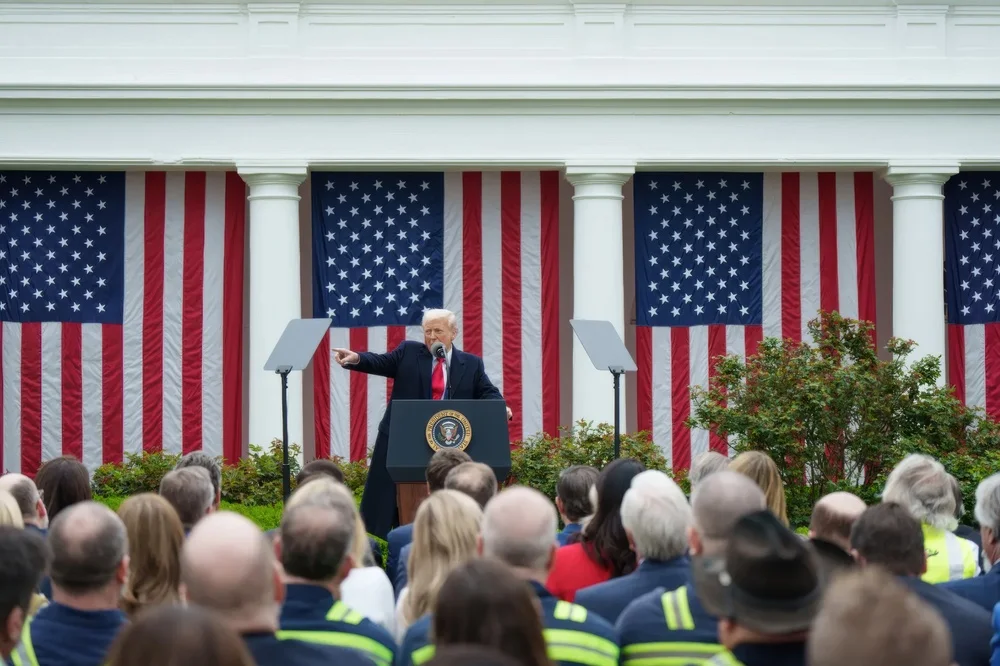
A Year of Tariff-Induced Stagnation
Broad-based tariffs won’t “liberate” anyone; they’re simply another way for the government to impose self-inflicted economic wounds.

The Tax Code Is the Abundance Agenda’s Missing Villain
A debate focused almost entirely on permitting and regulatory reform is insufficient. The tax code cannot remain a footnote. It is the missing villain.
.avif)




Get the Civitas Outlook daily digest, plus new research and events.
Get the Civitas Outlook daily digest, plus new research and events.